You shaped a beautiful loaf, tucked it into the fridge for an overnight cold proof, and then real life arrived. The overnight became a day. The day is turning into a second night. Now it is sitting there behind the milk, and you are standing at the open fridge door asking the question every home baker eventually asks: how long can sourdough actually sit in the fridge before I have to either bake it or throw it out?
Good news first — you almost certainly have not ruined it, and cold retarding is one of the most forgiving, most useful tricks in sourdough. But “forgiving” is not “infinite,” and the difference between a loaf that rewards the extra time and one that bakes into a flat, gummy disappointment comes down to reading the dough rather than the clock. Here is exactly how the cold retard works, how long you really have, and how to tell which side of the line your loaf is on.
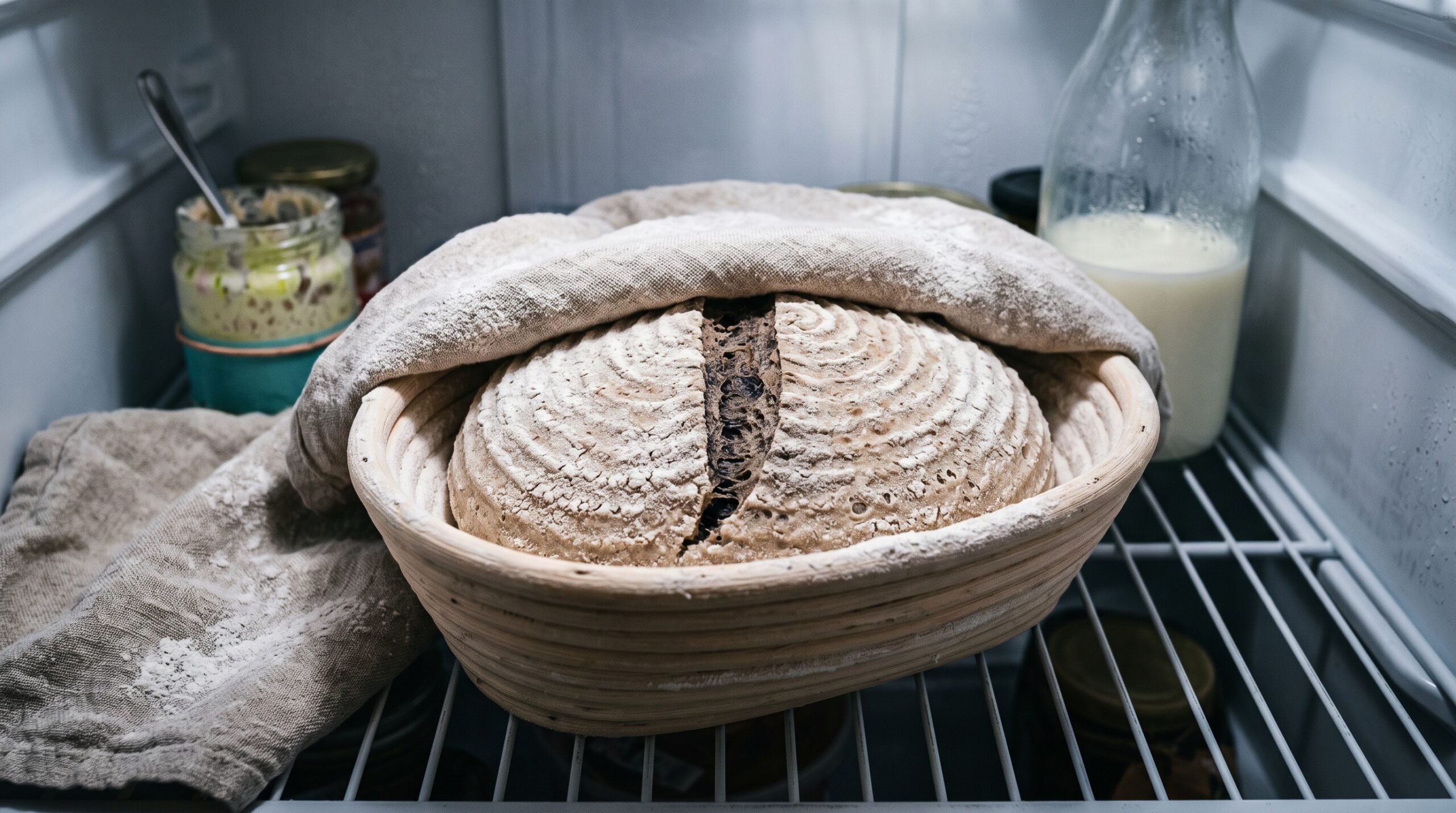
What Cold Retarding Actually Does
Fermentation is a temperature game. Warm dough ferments fast; cold dough ferments slowly. When you put a shaped loaf into a fridge running at the usual 38°F to 40°F, you are not stopping the yeast and bacteria — you are dropping them into slow motion. The yeast, which produces most of the gas that makes your loaf rise, goes nearly dormant in the cold. The bacteria that produce sourdough’s tang keep working, just gently. That split is the whole point of the technique.
Two things happen while your loaf chills. First, the rise slows to a near-standstill, which buys you a wide, flexible window to bake whenever it suits you. Second, those still-active bacteria keep developing acids and flavor, so a retarded loaf tastes deeper and more complex than one rushed straight from shaping to oven. Cold dough is also firmer and less sticky, which means it scores cleanly and gives you that dramatic ear. So a cold retard is not a compromise you make for convenience. It genuinely makes better bread — up to a point.
The Short Answer: How Long Is Safe
For most home bakers with a fridge in that 38°F to 40°F range, the practical, reliable window is 12 to 48 hours. Somewhere in there is the sweet spot for nearly every recipe. Twelve to sixteen hours is the classic overnight retard and the safest bet. Push to 24 or 36 hours and you gain flavor and a bit more convenience with very little risk, as long as your dough was not already racing when it went in. Reach toward 48 hours and you are near the edge: still very bakeable for most doughs, but you need to inspect before you commit.
Can you go to 72 hours? Sometimes — but only if the stars align. A 72-hour retard tends to work when your bulk fermentation was on the shorter side, your fridge runs genuinely cold, and your flour is strong enough to hold structure that long. Whole grain and rye doughs, which ferment faster and have weaker gluten, will overproof well before then. The number on the clock is a guide, not a guarantee. What actually decides it is the state of the dough, which is why you inspect rather than assume.

Signs It Retarded Just Right
Pull the loaf and look at it cold, before it warms up. A loaf in the sweet spot holds a gentle, confident dome. It has grown a little since you shaped it — noticeably risen but not ballooned. The surface shows a scattering of small bubbles, a good sign the fermentation kept ticking. Give it the poke test with a floured finger: press gently and the dent should spring back slowly and only partway, leaving a soft impression. That lazy, partial rebound is exactly what you want. The dough should feel alive and pillowy but still hold its shape when you tip it out of the banneton. If that is what you are seeing, stop worrying and start your oven.
Signs It Went Too Far (Overproofed in the Fridge)
Now the failure mode. A loaf that overproofed in the cold gives clear tells, and catching them saves you from a confusing bake. The surface looks slack, wet, and heavily bubbled, sometimes with large blisters that have started to collapse. When you turn it out of the banneton it spreads and flattens instead of holding a dome, oozing outward like it has given up. The poke test is the giveaway: press it and the dent stays put, or the dough deflates and sighs rather than springing back at all. You may also notice an aggressively sharp, almost acetone-adjacent smell — the sign fermentation has run well past its peak.
An overproofed loaf has exhausted its structure: the gluten can no longer trap gas, so it will bake flat and dense with a tight, gummy crumb and little oven spring. It is not dangerous, just disappointing. If you catch it here, you have options. Bake it anyway as a flatter loaf — it will still taste good and make excellent toast or croutons. Or reshape it into a pan loaf or focaccia, where a container does the job the gluten no longer can. Either way, log what happened: an overproofed retard almost always means the loaf went into the fridge too far along in its bulk ferment. Next time, chill it a little earlier.

How to Bake It Straight From the Cold
Here is the part that trips people up: do not let a retarded loaf come to room temperature before baking. Cold dough is a feature, not a problem. It is firmer, so it scores cleanly and holds a bold ear, and the cold center gives the outside time to set before the whole thing overspreads. Letting it warm up on the counter for an hour just invites overproofing and undoes the benefit you waited all night for.
So bake it cold. Preheat your Dutch oven thoroughly — a full 45 minutes at 475°F to 500°F — then take the loaf straight from the fridge, turn it onto parchment, score it decisively, and load it into the hot pot. The cold surface takes a sharp cut and the trapped steam does its work. Give it your usual covered-then-uncovered bake; a fridge-cold loaf sometimes wants an extra few minutes covered to fully spring, so judge by color and an internal temperature around 205°F to 210°F rather than the timer.
How to Stretch or Shorten the Window on Purpose
Once you understand the mechanism, you can steer the retard to fit your schedule instead of scrambling around it. To buy more time, put the loaf in the fridge slightly earlier — a touch under-proofed at room temperature — so it has room to finish slowly in the cold. Make sure your fridge is genuinely cold; the back of a lower shelf is coldest, the door is warmest. A colder fridge stretches your window; a warm, crowded one shrinks it.
To shorten or tighten the window, let the loaf proof a little more at room temperature before it goes in, so it needs only a short chill to be bake-ready. And remember the levers you already have: a dough built with strong bread flour, a firm shaping job, and a bulk ferment you did not push too far will all tolerate a longer, more forgiving retard. Weak flour, over-fermented bulk, and a warm fridge all narrow it. The retard does not have a fixed length — it has a length you design.

The Bottom Line
So, how long can sourdough sit in the fridge? For most loaves, 12 to 48 hours is comfortable, overnight is the safe classic, and 72 hours is possible when everything is in your favor. But the honest answer is the one your dough gives you: a gentle dome and a slow, partial spring back means bake it with confidence; a slack, spreading, non-rebounding loaf means it went too far, and the fix is to chill it earlier next time. Trust that read over any number, and the fridge stops being a source of panic and becomes what it should be — the most flexible, flavor-boosting tool in your kitchen.
Want to see the cold poke test and a straight-from-the-fridge bake in real time? The full walkthrough lives on the LoafLovers YouTube channel, and you can grab our free sourdough troubleshooting guide — a quick-reference for the symptoms, causes, and fixes that come up most — when you join the email list. No hard sell, just the answers waiting for the next time your schedule and your starter disagree.