You’ve dialed in your starter. You’re weighing your water, watching your dough temperature, timing your bulk ferment. And still the loaf comes out flatter and denser than the ones you see online — a little slack when you shape it, a little tight when you slice it. You’ve read every troubleshooting guide going, and nothing quite fits. Here’s a suspect most bakers never think to question: the flour itself.
Bread flour and all-purpose flour look identical in the bag. They are not identical in the bowl, and for sourdough — a long, wet, unforgiving process — the difference shows up in ways that are easy to blame on everything else. Let’s clear it up for good.
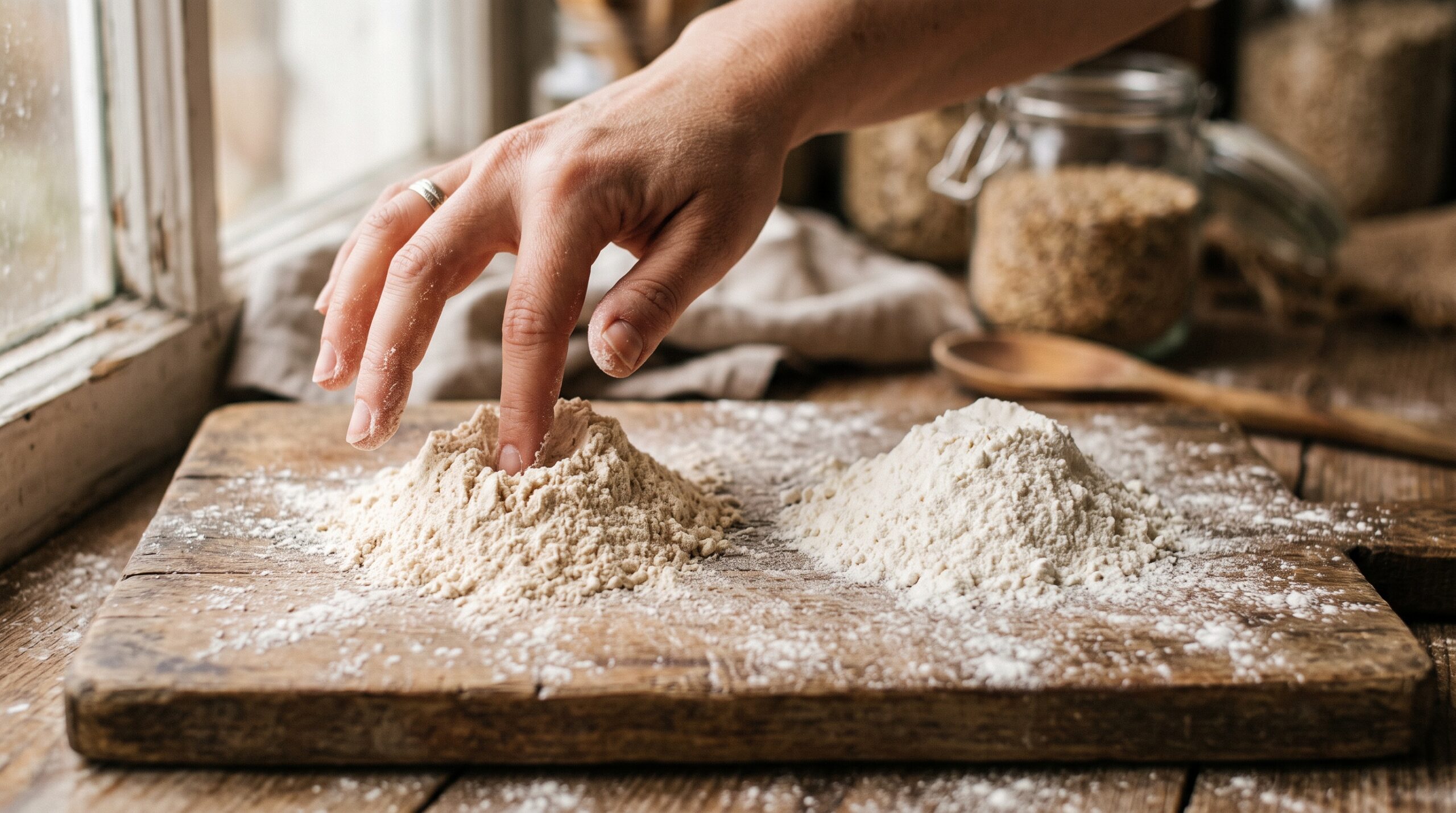
The short answer
For most home sourdough, bread flour is the easier, more forgiving choice, and if your loaves are chronically flat, slack, or dense, switching to it is one of the highest-leverage changes you can make. All-purpose flour can absolutely make good sourdough — plenty of bakers use it happily — but it asks more of you, and it’s less tolerant of the high hydration and long fermentation that give sourdough its open crumb.
The whole difference comes down to one number: protein content. And once you understand what protein is doing in there, every flour decision gets simple.
What “protein” actually means for your dough
The protein number printed on a flour bag isn’t nutritional trivia — it’s a strength rating. When flour meets water and gets worked, two proteins (glutenin and gliadin) link up into gluten: the stretchy, elastic web that traps the gas your starter produces and holds the loaf up as it rises. More protein means more potential gluten, which means a stronger dough that can stretch further, hold more gas, and keep its shape through a long ferment.
Here’s the rough landscape:
- Bread flour: about 12–14% protein. Milled specifically for yeasted bread. Strong, stretchy, gas-retaining — exactly what a wet, slow sourdough wants.
- All-purpose flour: about 9–12% protein. A compromise flour built to do a bit of everything, from cookies to pancakes to bread. Weaker gluten potential, so a softer, slacker dough.
One honest caveat worth knowing: protein varies a lot by brand and region. Some premium all-purpose flours run as high as 11.7%, nudging right up against weaker bread flours, while some supermarket all-purpose sits down near 9–10%. So “all-purpose” isn’t one thing — check the number on your bag. If your all-purpose is on the high end, it’ll behave much more like bread flour than a low-protein one will.

What happens when you bake sourdough with all-purpose
When you take a recipe written for bread flour and run it with lower-protein all-purpose — same hydration, same schedule — the weaker gluten shows up as a chain of familiar frustrations:
- The dough feels slack and sticky. There’s less gluten structure holding it together, so it stays loose and hard to handle, especially at higher hydration.
- The loaf spreads instead of standing tall. Weaker dough can’t hold tension, so it relaxes outward into a puddle rather than rising up. If you’ve been fighting flat, spreading loaves, low-protein flour is a leading cause.
- The crumb comes out tighter and denser. Gas escapes a weak gluten network instead of being trapped, so the airy, open crumb you’re chasing stays stubbornly small.
- It’s less forgiving of a long ferment. Over a many-hour bulk, weak gluten degrades faster, so your timing window shrinks and it’s easier to tip into an over-proofed, gluey loaf.
None of this means all-purpose is “bad flour.” It means you’re asking a compromise flour to do a specialist’s job at the specialist’s settings. Change the settings and it behaves.
When all-purpose flour is actually fine
Plenty of excellent sourdough is made with all-purpose, and there are whole categories where it’s genuinely a fine choice — sometimes even the better one:
- Softer, pan-baked loaves. A tender sandwich loaf baked in a tin doesn’t need to hold a dramatic free-standing shape, so all-purpose’s softer structure is no handicap — and can give a more tender crumb.
- Lower-hydration doughs. Less water means less demand on the gluten, so all-purpose copes fine. It’s the high-hydration, artisan open-crumb loaf where the gap really bites.
- Enriched and flatter bakes. Focaccia, discard recipes, pancakes, crackers — anything that isn’t relying on a tall, gas-filled rise — is perfectly happy on all-purpose.
- When your all-purpose is high-protein anyway. If your bag reads 11.5% or more, you’re already most of the way to bread flour; you may notice barely any difference.
So the real question isn’t “which flour is better?” It’s “which flour suits the loaf I’m trying to make?”

Whole wheat, rye, and the strong-flour spectrum
It’s tempting to assume more protein always equals more strength, and that whole grain flours — often labeled with high protein — must be the strongest of all. It’s the opposite in practice. Whole wheat and rye contain sharp bran particles and, in rye’s case, gums that physically interfere with the gluten network, so despite the protein number they build weaker, denser dough. That’s exactly why an all-whole-wheat loaf tends to come out heavy — a problem worth its own deep dive in why whole wheat sourdough turns out so dense.
At the other end sits bread flour, and beyond it high-gluten and “strong” bread flours (14%+) used for bagels and chewy crusts. For everyday sourdough you don’t need to go that far — ordinary bread flour, or a blend of bread flour with a modest percentage of whole grain for flavor, is the reliable home baker’s sweet spot.
How to adjust when you switch flours
The mistake isn’t using all-purpose — it’s swapping flours without changing anything else. Higher-protein flour absorbs more water than lower-protein flour, so a straight one-for-one swap at the same hydration gives you a dough that’s suddenly too wet or too stiff. When you change flour, change your approach with it:
- Going from all-purpose to bread flour? Add a little more water. Bread flour drinks more, so the same recipe will feel stiffer than you’re used to — nudge hydration up a few percent until the dough feels right.
- Going from bread flour to all-purpose? Hold back some water, or expect a slacker dough. This is a common reason a familiar recipe suddenly turns into a sticky, unmanageable mess — the flour changed but the water didn’t.
- Trust the dough, not the number. Add water gradually and judge by feel: it should be soft and extensible but still hold together, not soupy. Your hands are a better gauge than any recipe percentage.
- Watch your fermentation window. Weaker flour degrades sooner over a long bulk, so if you move to all-purpose, err on the side of pulling the dough a touch earlier.

The bottom line: what to buy
If you want the easiest path to a tall, open, well-risen sourdough, buy bread flour and build your recipe around it. It’s more forgiving of the high hydration and long ferment that define good sourdough, and it quietly fixes a whole cluster of slack-dough, flat-loaf, tight-crumb complaints in one move.
If all you have is all-purpose, don’t panic — check its protein content, lean toward slightly lower hydration and slightly shorter bulk, and pick loaf styles that play to its strengths. You’ll make very good bread. You’ll just work a little harder for the dramatic open crumb.
So does the flour really matter? For a cake, barely. For sourdough — a process that lives or dies on gluten strength — it’s one of the most underrated variables on the counter. The next time a bake goes mysteriously flat or dense and your starter and schedule check out, turn the bag around and read the protein number. The answer is often right there.

Want to see the difference between a slack, weak dough and a strong one in real time? The full visual walk-through — plus our free sourdough troubleshooting guide — lives on the LoafLovers YouTube channel. Come get the fix that finally makes it click.