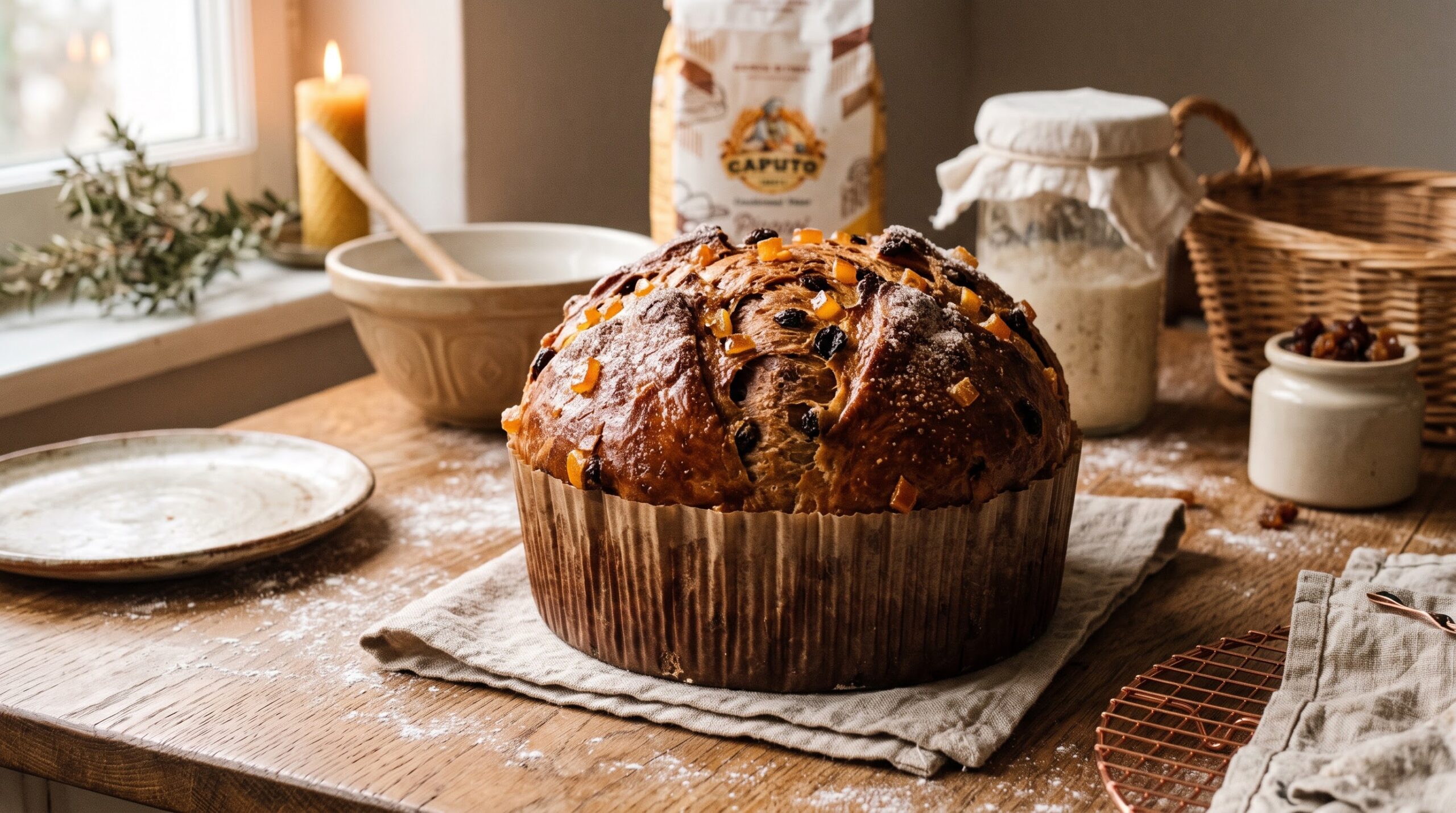
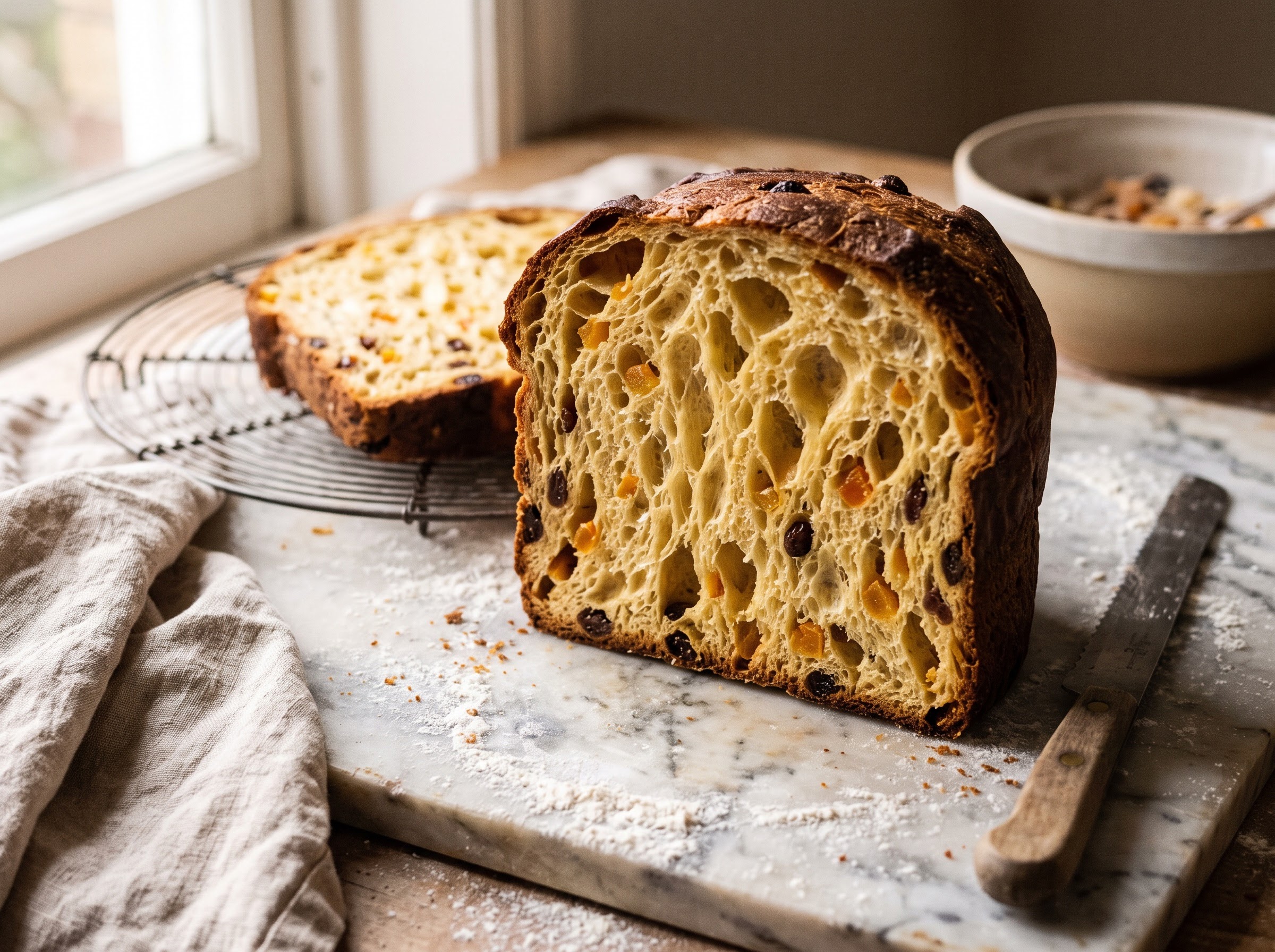
If there is one sourdough bake that rewards planning over luck, it is panettone. That tall, golden, cloud-soft Italian Christmas bread — all buttery strands and candied fruit, light enough to pull apart with your fingers — is widely considered the hardest thing a home baker can attempt. And when it is leavened entirely by your own starter, with no commercial yeast at all, it moves from “ambitious weekend project” to “genuine test of everything you know.”
Here is the honest truth that every panettone guide buries in the footnotes: the single most important ingredient is time, and you have to commit to it weeks before the loaf ever goes in the oven. If you want a sourdough panettone on the table this Christmas, mid-November is not early — it is right on schedule. This isn’t a recipe you can decide to make on December 23rd. Let’s walk through why it takes so long, and how to give yourself a real shot at success.
Why panettone is the Everest of sourdough
Ordinary sourdough is water, flour, salt and starter. Panettone throws all the hardest variables at you at once. It is an enriched dough taken to an extreme — loaded with butter, egg yolks, sugar, and candied fruit. Every one of those additions actively fights the rise. Fat coats the gluten strands and weakens them; sugar pulls water away from your yeast and slows fermentation; the sheer weight of all those enrichments has to be lofted sky-high by nothing but wild yeast.
On top of that, panettone has an almost absurd standard of success. It must rise into a tall dome, develop a crumb so light it is nearly weightless, pull apart into long silky strands rather than crumbling, and stay soft for days. If you have ever wondered why real artisan panettone costs what it does, this is why: it is a slow, delicate, multi-day feat of fermentation engineering. Understanding how much the butter, milk and egg in an enriched dough change the entire bake is the right place to start before you ever attempt one.
It all rides on your starter — and that is why you start now
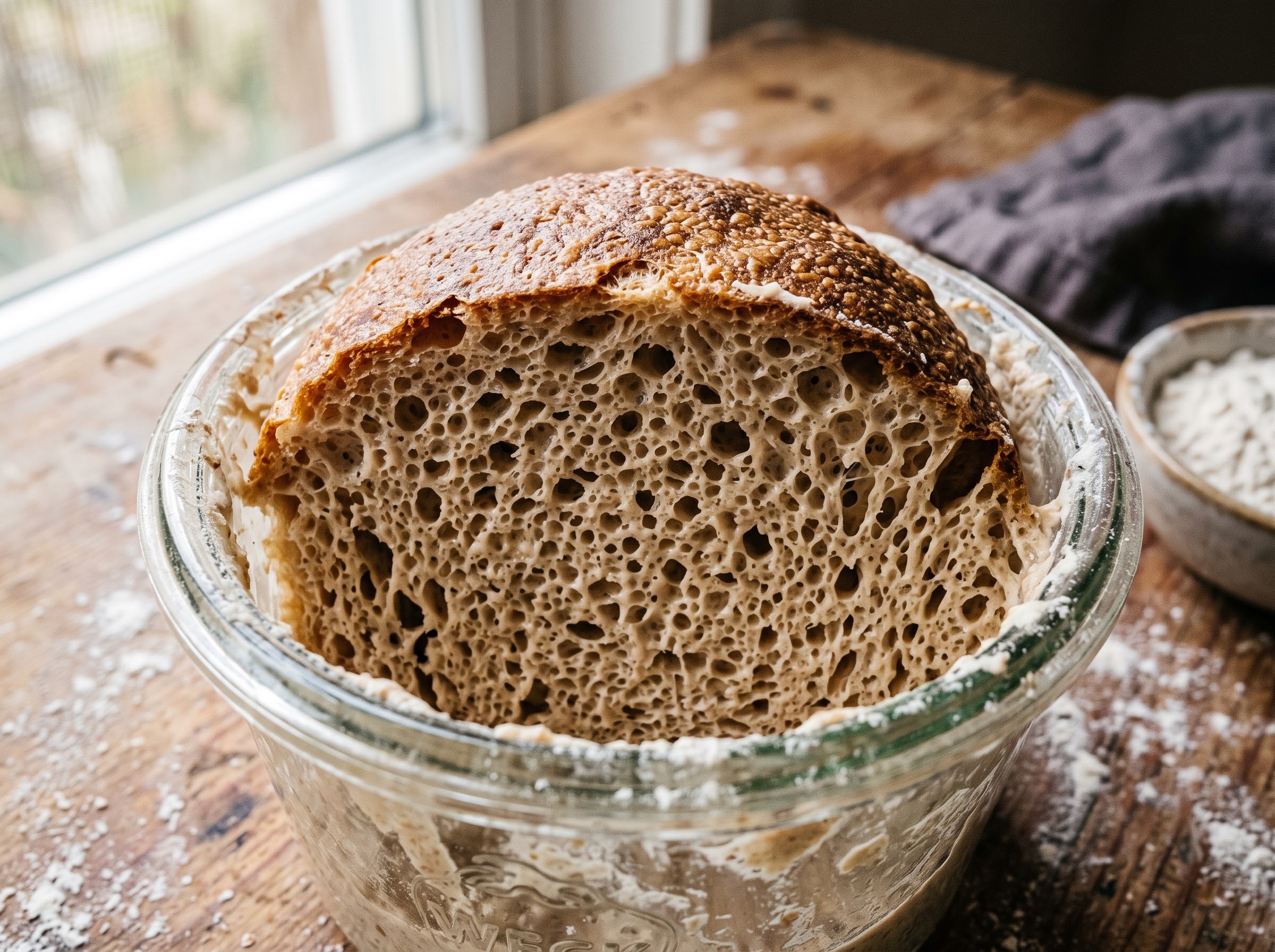
This is the part that catches people out. You cannot leaven a dough this heavy with a tired, sluggish, once-a-week fridge starter. Panettone demands a starter at the absolute peak of its powers: fast, vigorous, mild-tasting, and so strong it can triple in volume in a handful of hours. Most home starters simply aren’t in that condition day to day — and getting one there takes weeks of consistent, frequent feeding. That is the real reason this bake has to begin in mid-November.
Traditional Italian bakers use a stiff starter — a low-hydration dough-like culture often called lievito madre or pasta madre — rather than the loose, pancake-batter starter most of us keep. A stiff starter ferments more gently, builds more strength, and develops a milder, sweeter flavor that suits a dessert bread far better than the tangy sourness of a wet culture. In the weeks before the bake, it is fed once, twice, even three times a day to build it into a powerhouse. If your starter doubles happily but your loaves still don’t rise the way you expect, that disconnect is worth fixing now, long before panettone day — here is why a starter that doubles can still leave your bread flat.
Dialing in the feeding is the whole game in these weeks. You are chasing a predictable, fast, reliable rise, which means getting your ratios and timing consistent. Our breakdown of sourdough feeding ratios and when to use each will help you push your culture toward that peak-strength, fast-tripling condition panettone needs.
The two-dough method: why panettone takes two days (at least)
Even once your starter is ready, you don’t just mix a panettone and bake it. The classic method uses two separate doughs built over two days:
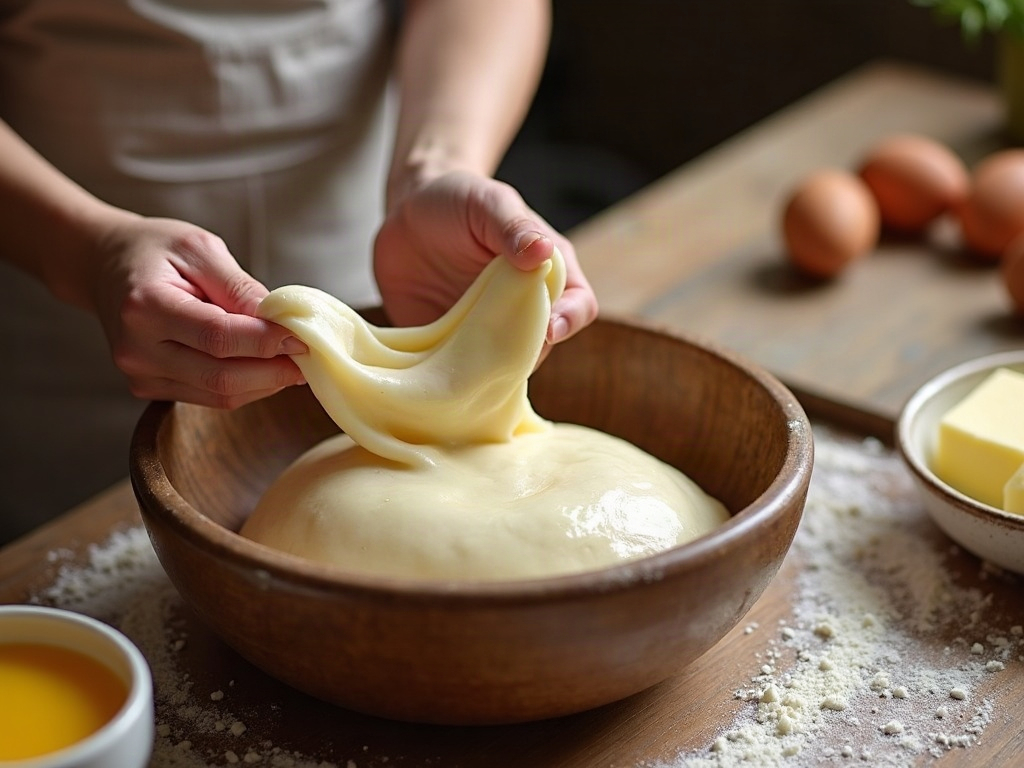
- The first dough (primo impasto). In the evening, you mix your peak starter with flour, water, sugar, egg yolks and some of the butter into a base dough. Then it ferments slowly overnight — often 10 to 14 hours — until it has tripled. This long, patient first rise is where the lightness is built.
- The second dough (secondo impasto). The next morning, that risen dough becomes the foundation for the final mix: more flour, more sugar, more yolks, honey or vanilla for aroma, the rest of the butter, and finally the candied fruit and raisins folded in last.
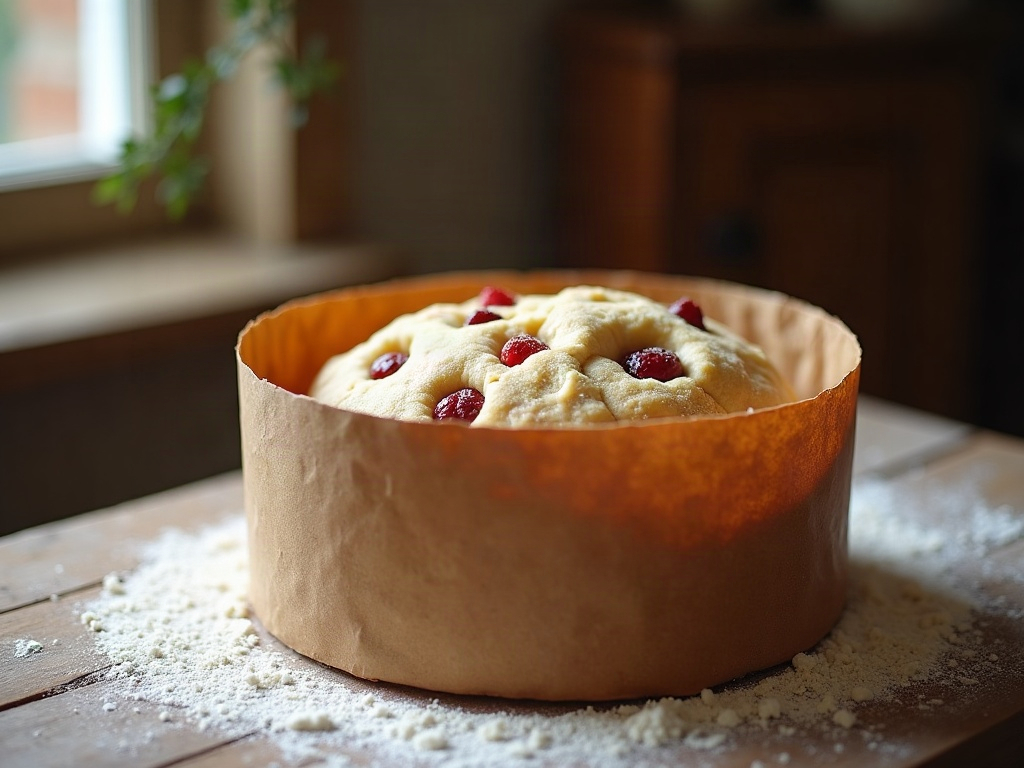
Between and after those steps come more long proofs. The shaped dough can take many hours to crest its mold. All told, from the final feed of your starter to a cooled loaf, you are looking at the better part of three days of active involvement — sitting on top of those weeks of starter conditioning. Panettone is not hard in the sense of requiring flashy skill; it is hard in the sense of requiring patience and respect for the clock.
Where home bakers go wrong (and how to dodge it)
Most failed sourdough panettones fail for one of a few predictable reasons. Knowing them in advance is half the battle:
- A starter that wasn’t strong enough. By far the most common cause of a dense, squat, or barely-risen panettone. There is no rescuing this mid-bake — the fix happens in the weeks beforehand, which is the entire point of starting now.
- Adding the butter too fast. The enrichments must go in gradually, a little at a time, letting each addition fully incorporate before the next. Dump it all in at once and the fragile gluten shears apart and the dough turns to a greasy soup that will never hold air.
- Rushing the proofs. Sourdough panettone will not be hurried. If you bake before the dough has genuinely crested its mold, you get a heavy loaf; if you panic and warm it too aggressively, you risk the butter weeping out. Warm, patient, and unhurried wins.
- Skipping the upside-down hang. This one surprises first-timers. A fresh panettone is so delicate and airy that it will collapse under its own weight as it cools. The traditional fix is to skewer it through the base and hang it upside down until completely cool, so the tender structure sets without sinking. Don’t skip it.
Should you even attempt it? An honest answer
Here is where we’ll be straight with you, because that is what this site is for. If you are a newer baker still fighting flat loaves and a temperamental starter, a full sourdough panettone this year may be a bridge too far — and that is completely fine. It is a genuinely advanced bake, and there is no shame in building up to it.
But — and this matters — the process of getting your starter panettone-ready is some of the best training you can give yourself. Feeding a starter to peak strength, learning to read it, handling an enriched dough gently: those skills make every loaf you bake better. So even if the panettone itself ends up a little dense this first time, the weeks of practice are never wasted.
If you’d rather ease into festive sourdough baking with something more forgiving this year, a cranberry walnut sourdough holiday loaf gives you the seasonal flavors and the celebratory feel without the three-day high-wire act. Then make panettone your project for next year, with a starter you’ve spent twelve months getting to know.
Your mid-November starting line
If you’re in, here is what to do this week to stay on schedule: pull your starter out of its slow fridge rhythm and begin feeding it daily at room temperature, watching for a faster, taller, more reliable rise each day. Consider converting a portion to a stiffer, lower-hydration culture to build strength and mellow the flavor. Source your ingredients early — good candied orange, quality butter, and strong bread flour are worth hunting down before the holiday rush empties the shelves. And read your chosen recipe end to end, twice, so the two-dough timeline holds no surprises on the day.
Panettone is the bake that humbles experienced sourdough bakers and rewards the patient ones. It cannot be faked, rushed, or pulled off at the last minute — which is exactly what makes a tall, golden, hand-torn homemade one so deeply satisfying to set on the table. Start your starter now, respect the clock, and give yourself the runway to do it properly.
Panettone is a bread you really want to see made before you attempt it — the way the dough climbs the hook, the butter going in, the upside-down hang. The full step-by-step sourdough panettone build, with the starter schedule and the two-dough timeline laid out in real time, lives on the LoafLovers YouTube channel, and our free sourdough troubleshooting guide includes a printable starter-strength checklist to get your culture panettone-ready. Start now, bake slow, and let this be the Christmas you pull a real one out of the oven.