Here’s the scene that sends more bakers back to square one than almost any other. The crust came out deep and glossy, the timer had gone off, the kitchen smelled incredible — so you pulled the loaf, felt proud, and let it cool. Then the next morning you sliced in and found it: a dense, slightly damp band hugging the bottom crust, the crumb above it a little tight and claggy. It looked done. It wasn’t.
The frustrating part is that “golden crust” and “the timer went off” are the two signals most of us instinctively trust, and neither one actually tells you what’s happening in the middle of the loaf. A big round of high-hydration sourdough holds a startling amount of water, and the center is the last place to finish. The good news: there is one test that removes all the guesswork, plus a couple of reliable backups. Let’s make “is it done?” a question you can answer with confidence instead of hope.
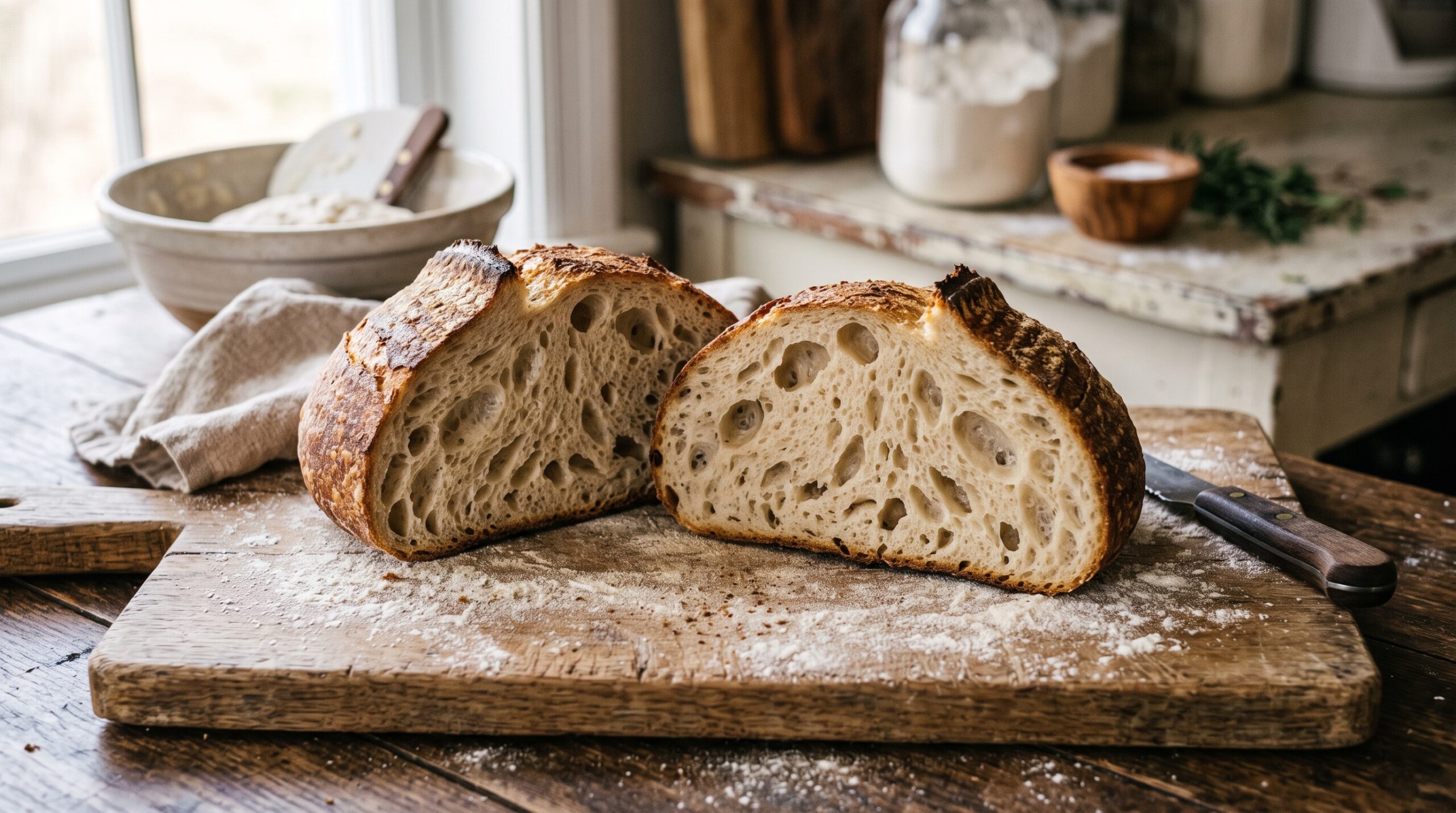
What “done” actually means inside the loaf
Baking bread isn’t just about browning the outside. Inside, two things have to finish. First, the starch has to gelatinize and then set — the granules swell, absorb water, and lock into a stable structure as they cool. Second, enough moisture has to drive off so the crumb is springy rather than paste-like. Both of those happen at a specific interior temperature, and they happen well after the crust has already colored.
That’s the trap. The crust browns through the Maillard reaction and caramelization at surface temperatures far above what the center ever reaches. So the outside can look gorgeous while the core is still a good 10–20°F short of set. Pull it there and the unfinished starch stays gummy, especially in the densest, wettest part of the loaf: the bottom third, where gravity has pulled moisture down all bake long.
The single most reliable test: internal temperature
If you take one thing from this article, take this: buy an instant-read digital thermometer and probe the center of the loaf. It costs less than a banneton and it ends the doneness argument permanently.
Insert the probe into the thickest part of the loaf, ideally angling in from the base so you don’t leave a mark on your scored top, and push it toward the geometric center. Then read the number:
- 205–210°F (96–99°C) is the target for most rustic sourdough. This is the sweet spot where the crumb is fully set but not dried out.
- Below about 200°F (93°C) and the center is very likely still underdone — expect that damp, tight band. Put it back in.
- Enriched or pan loaves (with butter, milk, or eggs) finish a touch lower, around 190–200°F, because the fats and sugars change how they set.
One honest caveat: temperature is necessary but works best alongside time. A loaf that hits 208°F in the last five minutes of a rushed bake can still read a little gummy if the crumb hasn’t had enough total heat to properly dry. In practice this is rare — if your bake time is in the normal range and you’re hitting 205–210°F, you’re done. Trust the number over the clock and over the crust color every single time.

The backup signals when you don’t have a thermometer
No probe on hand? These won’t be as precise, but stacked together they get you close.
The hollow thump. Turn the loaf over and knock the base firmly with two fingers or a knuckle. A finished loaf sounds hollow and resonant, like a small drum. A dull, muffled thud means there’s still dense, moist crumb absorbing the sound — give it more time.
Weight in the hand. A properly baked loaf feels surprisingly light for its size because so much water has left as steam. If it feels heavy and dense relative to how big it looks, moisture is still trapped inside.
Crust that’s set, not soft. The whole crust — including the bottom and sides — should feel firm and crisp, not leathery or bendy. A base that gives when you press it usually means the loaf came out early.
The color floor. Aim for a genuinely deep, rich brown, not a timid tan. Underbaked loaves are almost always pale as well as damp. Color alone isn’t proof of doneness, but a pale crust is a reliable sign it’s not done. Bake bolder than feels comfortable; sourdough can take it.
Why your loaf looks done but isn’t
If you keep pulling loaves that turn out gummy despite looking perfect, the cause is usually one of these:
Your oven runs cooler than the dial says. Home ovens are routinely off by 15–25°F, and many cycle their heat unevenly. If the crust is browning on schedule but the center never catches up, an inexpensive oven thermometer will often reveal the real temperature is well under what you set. Calibrate to reality and your bakes get instantly more predictable.
The crust raced ahead of the crumb. Baking too hot, or with the loaf too high in the oven, browns the outside before the inside can finish. If the crust hits deep brown but a probe reads low, drop the temperature 15–25°F for the remainder and keep baking — the center will catch up without burning the exterior.
You baked lidded the whole time. A Dutch oven traps steam beautifully for oven spring, but leaving the lid on for the entire bake keeps the crust soft and can leave the interior underset. Take the lid off for the final third of the bake so the crust can firm and the loaf can finish drying.
The loaf was simply too big or too wet for the time you gave it. High-hydration and larger loaves need more minutes, full stop. Don’t be afraid to add 5, 10, even 15 minutes — a probe reading tells you exactly when to stop.

How to rescue a loaf you think is underbaked
Caught it before it fully cooled? You can often still save it. If the loaf has been out for only a few minutes and you suspect the center is short, put it straight back into a hot oven — no lid, directly on the rack — for another 8–15 minutes, then probe again. It won’t be as flawless as a loaf baked correctly the first time, but it will be far better than a gummy center, and completely edible.
If you only discover the problem after it’s fully cooled and sliced, re-baking whole won’t help much. Your best move is to slice the loaf and toast it — toasting drives off the extra moisture and firms up that damp band nicely. And take the lesson into the next bake: longer, hotter enough to set, and probe before you commit.
The cooling rule almost everyone breaks
Here’s the twist that fools even careful bakers: a perfectly baked loaf can still read as gummy if you cut it too soon. The bake isn’t truly over when the loaf leaves the oven — the crumb keeps setting as it cools, and the residual heat continues driving out moisture. Slice into a warm loaf and you’ll drag the knife through crumb that hasn’t finished, compressing it into a doughy smear that looks exactly like underbaking.
So give it time. Cool the loaf completely on a wire rack — not on a solid surface, which traps steam and softens the bottom crust — for at least an hour, and closer to two for a large, dense, or high-hydration loaf. It’s the hardest hour in baking, but it’s the difference between a crumb that shows off all your work and one that makes you doubt a loaf that was actually just fine.

Put it together and doneness stops being a guess: bake bold, probe for 205–210°F, back it up with a hollow thump and a light, firm loaf, and then let it cool all the way. Do that and the gummy-bottom slice becomes a memory instead of a monthly heartbreak.

Want to see the thermometer test, the hollow-thump knock, and the difference between an underbaked and a fully set crumb in real time? The full walkthrough lives on the LoafLovers YouTube channel, and our free sourdough troubleshooting guide breaks down every stage from starter to slice — grab it and we’ll help you nail the next bake, all the way to the center.