Every year it’s the same small guilt: a heel of sourdough gone rock-hard on the counter, too stale to slice, too good to bin. Here’s the reframe that changes your whole holiday table – that stale loaf isn’t waste. It’s the best stuffing you’ll ever make, and it’s genuinely better than anything you’d get from a soft sandwich loaf or a bag of dusty cubes.
Sourdough brings three things to dressing that nothing else does: a sturdy, open crumb that soaks up stock without collapsing, a faint tang that cuts through all that richness, and a crust that crisps into savory little edges. The catch is that stuffing is where two opposite failures meet – soggy bread pudding on one end, dry croutons on the other. This guide walks the narrow path between them.

Why stale sourdough is the secret, not a compromise
Fresh bread is full of moisture, and moisture is the enemy here. Cube a fresh loaf, drown it in stock, and the cell walls give up – you get a dense, gummy paste. Properly dried bread behaves completely differently: the starch has firmed up, so each cube acts like a little sponge with a backbone. It drinks in the flavored liquid and holds its shape, giving you that ideal contrast of crisp top and tender, custardy interior.
Sourdough’s structure makes this even better. Those irregular holes from a long fermentation create more surface area to catch stock and more edges to crisp. And the mild acidity balances the butter, stock, and fat from the bird so the whole dish tastes savory rather than heavy. If you’ve only ever had stuffing from soft white bread, sourdough is a real upgrade – more texture, more depth, less of that one-note squish.
Drying the bread: the step people skip and regret
You have two routes, depending on how far ahead you planned.
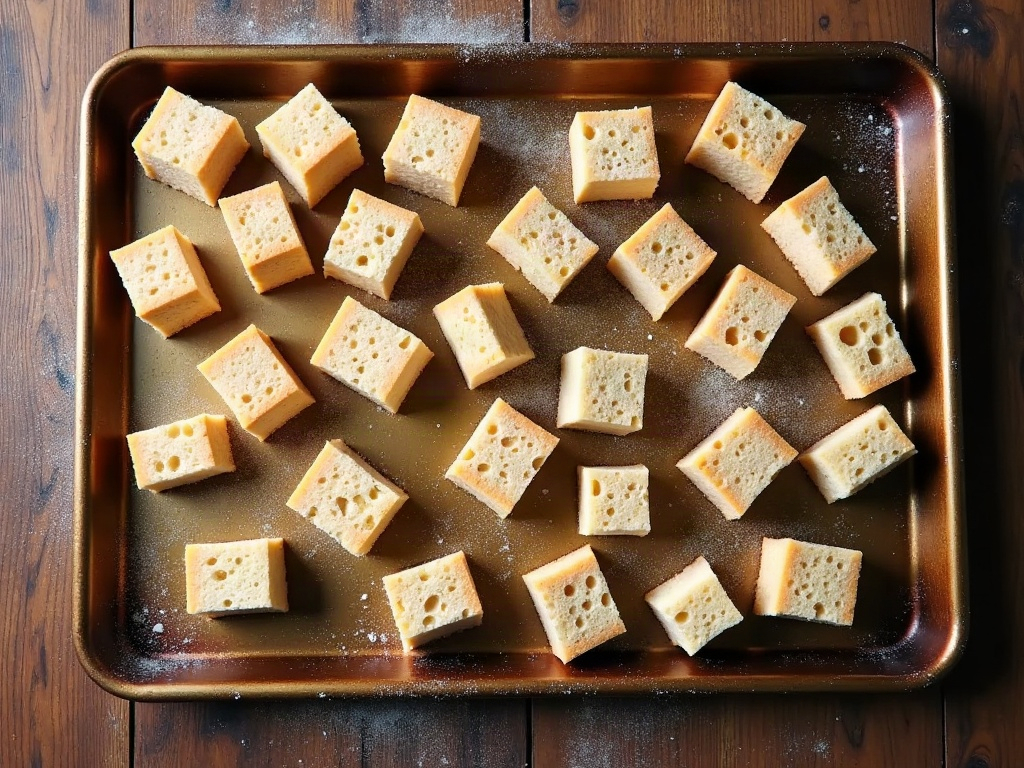
If you have a day or two: Cut the loaf into roughly 3/4-inch to 1-inch cubes – uneven is fine, the ragged bits crisp up beautifully – and spread them in a single layer on sheet pans. Leave them out, uncovered, for 24 to 48 hours, tossing once. You want them dry to the center and firm enough to knock together with a dry sound.
If you forgot (most of us): Spread the cubes on sheet pans and dry them in a 275°F (135°C) oven for 40 to 50 minutes, tossing every 15, until they’re crisp and pale-golden but not toasted dark. Let them cool fully. Don’t rush this with high heat – you want them dried out, not browned, so they still have room to take on color later.
Either way, the test is simple: a finished cube should feel light, sound hollow, and have no cool, damp give in the middle. Damp cubes are the number-one cause of gluey stuffing.
Building real flavor: aromatics and herbs
Stuffing lives or dies on its base, and the base is butter and aromatics. For a loaf’s worth of cubes (about 10-12 cups), melt a generous half-cup (1 stick) of butter in a large skillet and sweat a big diced onion and 3-4 ribs of celery, with a good pinch of salt, until soft and translucent – 8 to 10 minutes. No rushing and no browning the onion hard; you want them sweet and mellow.
Then the herbs. Fresh sage, thyme, and a little rosemary are the classic holiday trio – add them in the last couple of minutes so they bloom in the butter without going bitter. A couple of cloves of garlic, some black pepper, and a handful of chopped parsley stirred in at the end round it out. If you like a little sweetness and texture, this is the point to fold in cooked, crumbled sausage, sauteed mushrooms, or toasted nuts – but a plain herb version is a thing of beauty on its own.
The stock-and-egg ratio that makes or breaks it
This is the part everyone fears, so let’s make it foolproof. The goal is cubes that are evenly damp and springy – think a well-wrung sponge – not floating in liquid.
In a very large bowl, toss the dried cubes with the buttery aromatics. In a separate bowl, whisk 2 to 2.5 cups of warm chicken or vegetable stock with 2 large eggs. The eggs are doing quiet but crucial work: they set as the stuffing bakes, binding everything into a soft custard that holds together on the spoon instead of falling apart.
Now add the liquid gradually. Pour in about two-thirds, fold gently, and wait a minute – dry sourdough takes a moment to absorb. Press a cube: it should be moist and yielding but still hold its edges. Add more stock a splash at a time until every cube is damp and the mixture just barely holds together when you squeeze a handful. It should look generously moist but never soupy. Under-saturated is easy to fix later; drowned is not.

Baking: covered, then uncovered, for the best of both
Butter a baking dish and pack the stuffing in loosely – don’t compress it, or you’ll squeeze out the air that keeps it light. Here’s the two-stage trick for that crisp-top, tender-middle result:
Cover tightly with foil and bake at 350°F (175°C) for 25 to 30 minutes. This traps steam, cooks the interior through, and lets the eggs set into a soft custard. Then pull the foil, dot the top with a little more butter, and bake uncovered for another 20 to 30 minutes until the top is deeply golden and crackly. The internal temperature should reach about 160°F (71°C) if you want to check.
A note on the old debate: baking it in a dish like this is technically dressing, and it’s the safer, crispier choice. Packing it inside the bird gives you soggier bread and a food-safety headache. Keep it in its own dish and you get far more of those crunchy edges everyone fights over anyway.

Make it ahead so the big day is calm
Stuffing is one of the most forgiving make-ahead dishes, which is exactly what you want when the oven is a battlefield. Dry the bread cubes up to a week early and store them airtight at room temperature. You can cook the aromatics a day or two ahead and refrigerate them too.
You can even assemble the whole thing (cubes, aromatics, and stock-egg mixture) the night before, cover, and refrigerate. Pull it out while the oven comes up to temperature, add a small splash of stock if it looks like it tightened up overnight, and bake as above – you may need a few extra covered minutes straight from the fridge. Leftovers reheat well, covered, with a little stock to revive them.
Troubleshooting: soggy, dry, or bland
Three failures, three quick fixes:
Soggy or gluey: The bread wasn’t dry enough, or you added too much stock too fast. Next time, dry the cubes harder and hold back liquid – add it in stages. To rescue a too-wet batch mid-process, fold in a handful of extra dry cubes and bake uncovered a little longer to drive off moisture.
Dry or crumbly: Not enough stock, or it baked uncovered the whole time. The foil stage is what keeps the middle tender. If a baked batch came out dry, drizzle warm stock over it and cover for 10 minutes in a low oven – it’ll soften right back up.
Bland: Under-salted or under-buttered. Stuffing needs more seasoning than you’d expect because the bread dilutes everything. Taste the aromatics before you combine, and don’t be shy with salt, pepper, and fresh herbs.

Get the bread dry and the liquid gradual, and sourdough stuffing is close to impossible to ruin – and it quietly becomes the dish people ask you to bring every year. That stale heel on the counter has a job now.
Want the visual version – the cube test, the squeeze test, and the two-stage bake – walk through it on the LoafLovers YouTube channel, and grab our free sourdough troubleshooting guide if you’d like the rest of our fixes in one place.
Leave a Reply