You open the fridge, reach past the leftovers, and there it is: your sourdough starter, looking nothing like the bubbly, living thing you put away. It’s flat. Dense. There’s a greyish liquid sitting on top, and it smells sharp — a bit like old beer or nail polish. Your stomach drops. You’ve killed it. You left it too long, you forgot about it, and now it’s dead.
Take a breath, because almost certainly none of that is true. A starter you keep in the fridge is supposed to look flat and unimpressive. Cold storage doesn’t kill your starter; it puts it to sleep. The real question — the one that quietly stresses out every home baker — is how often you actually have to feed the thing to keep it healthy. The honest answer is probably far less often than you think.
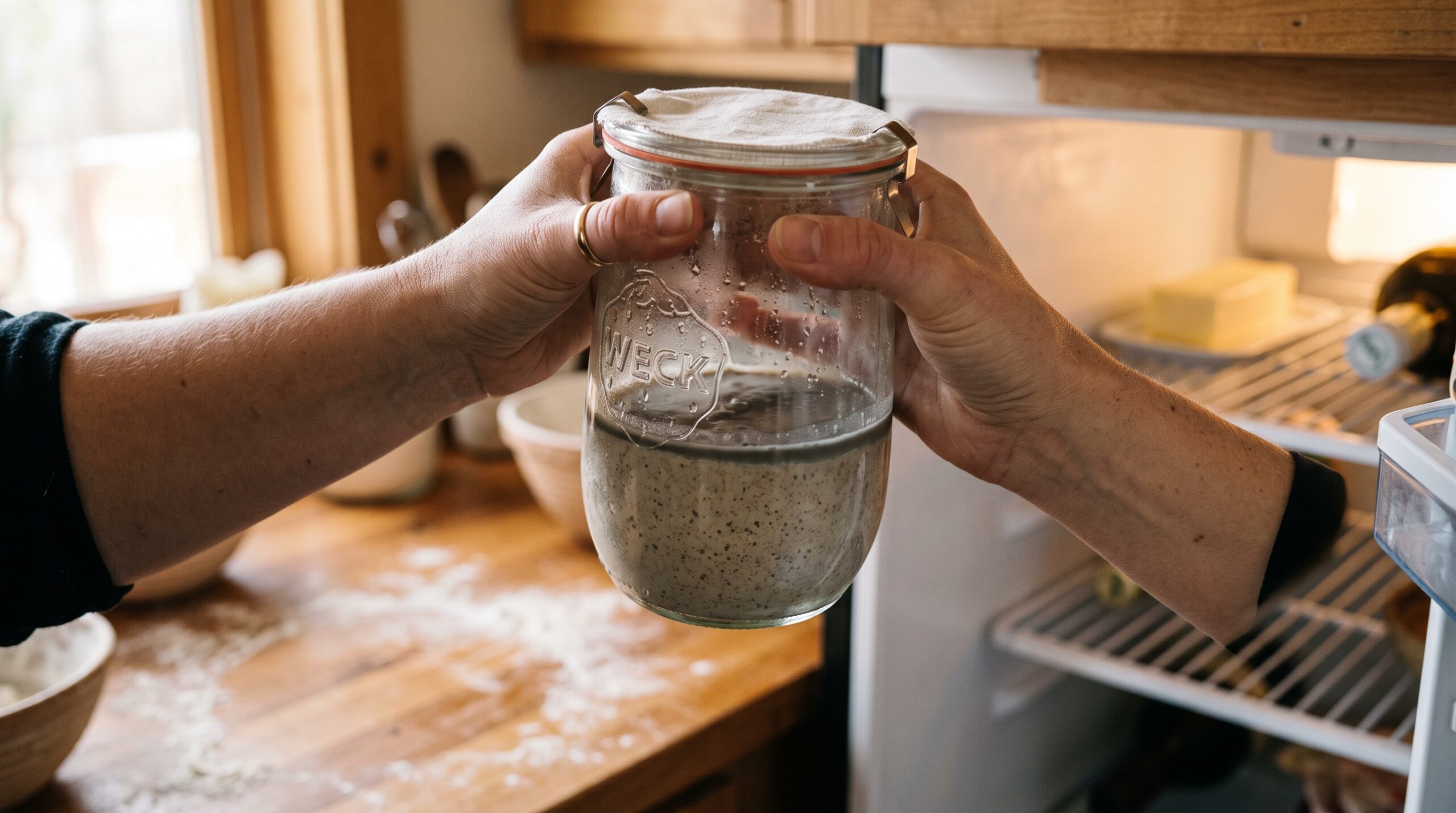
What the fridge actually does to your starter
Your starter is a colony of wild yeast and bacteria, and like any living culture, its activity is driven by temperature. On the counter at room temperature, those microbes are wide awake: eating the flour you feed them, multiplying, and producing the gas that makes the starter rise and fall over a matter of hours. That’s why a counter-kept starter demands feeding once or even twice a day — it burns through its food fast.
Move it into the fridge and everything downshifts. At around 4°C (39°F), the yeast and bacteria slow to a crawl. They don’t stop entirely — the culture keeps ticking over very slowly — but instead of consuming its food in hours, it now stretches that same meal across days or weeks. The flat appearance isn’t decline; it’s hibernation. The starter is dormant, conserving energy, waiting for warmth and fresh flour to wake it back up.
Two things do keep happening slowly in the cold, and both are harmless. The bacteria continue making acids, so a fridge starter gets more sour and more acidic over time. And as the culture digests its food and runs low, a layer of liquid — that greyish booze on top, called hooch — can separate out. Neither is a problem. If you want the full breakdown of what that liquid means, we’ve covered hooch on your starter and exactly what to do about it, but the short version is: it’s just a thirsty starter asking to be fed.
The honest answer: how often to feed a fridge starter
For a starter you keep in the fridge and bake with regularly, once a week is the comfortable, sustainable rhythm. That single weekly feed keeps the culture well-nourished, keeps the acidity in a healthy range, and means it’s rarely more than a feed or two away from being bake-ready. If you bake most weekends, a Sunday-night feed-and-chill routine is honestly all the maintenance most home bakers ever need.
But — and this is the part that relieves a lot of anxiety — a healthy, established starter is far tougher than that. It can comfortably go two to three weeks in the fridge without a feed and bounce right back. It’ll be hungrier, more acidic, and will take an extra feed or two to hit full strength, but it is not dead. Many bakers have forgotten a starter for a month or more and revived it without trouble. The fridge buys you an enormous amount of forgiveness.
So the practical schedule looks like this:
- Baking weekly: feed once a week, store in the fridge between bakes. Easiest and most reliable.
- Baking occasionally: feed every one to two weeks, or simply feed it when you take it out to bake and again when you put it away.
- Not baking for a while: a feed every two to three weeks keeps it in great shape; even a monthly feed will usually keep it alive.
Notice what matters here: it’s not a rigid clock. A fridge starter is governed by how hungry it is, not by a missed appointment. Which means you need to be able to read it.

How to tell your fridge starter is hungry, not dead
This is the skill that frees you from the calendar. Before you panic about a neglected jar, run through the signs — the overwhelming majority of “dead” fridge starters are simply very hungry.
Hooch on top. A layer of grey or amber liquid means the culture has eaten through its food and is thirsty. Stir it back in for a more sour result, or pour it off for a milder one, then feed. This is the number-one sign of hunger, not death.
A sharp, boozy, or acetone-like smell. Vinegary, alcoholic, or nail-polish-remover notes all point to an acidic, underfed starter — again, hunger. A healthy fed starter smells pleasantly tangy and yeasty, a bit like plain yogurt. If yours has drifted into solvent territory after weeks in the cold, that’s normal and fixable. (If it has genuinely been neglected for a long time, our guide to reviving a neglected starter even when it smells like nail polish walks through the full rescue.)
What actual spoilage looks like. The only real warning sign is mould — fuzzy spots of pink, orange, black, or blue-green growth, often raised and dry-looking rather than the flat liquid of hooch. Or a smell that is genuinely rotten or foul rather than sharp and sour. If you see fuzzy mould, don’t try to save it; start fresh. But this is rare in a regularly used starter, and hooch and a sharp smell are not mould.

Your five-minute weekly maintenance routine
Here’s the whole ritual, start to finish. It’s genuinely quick once it’s a habit:
- Take the jar out of the fridge. No need to let it warm up first for a maintenance feed.
- Stir in or pour off any hooch. Your call on sourness.
- Discard most of it, keeping only a small amount — a tablespoon or two (roughly 20–50g). Keeping less starter means you use less flour to feed it. If the constant discarding bothers you, you don’t have to waste it; we’ve got a jar’s worth of ideas for what to do with sourdough discard instead of throwing it away.
- Feed by weight at a 1:1:1 ratio — equal parts starter, fresh flour, and water (for example 25g starter, 25g flour, 25g water). Stir until smooth.
- Back in the fridge. You can chill it straight away, or leave it on the counter for an hour or two to get the fermentation going first if it’s been dormant a long while. Either works for simple maintenance.
That’s it. Five minutes, once a week, and your starter stays happy indefinitely. And resist the urge to over-correct a hungry starter with a giant feed every time — bigger isn’t always better, as we explain in whether you can over-feed a starter.

Waking it up before you bake
Maintenance feeding keeps your starter alive. But a starter pulled straight from the fridge is cold, sluggish, and not strong enough to leaven a loaf well on its own. Before you bake, you need to wake it up — and this is where the “how often” question meets the “how do I actually use it” question.
Start the day before you want to bake. Take the jar out, discard down to a small amount, and feed it at room temperature. Give it 4 to 12 hours in the warmth until it’s bubbly and has risen. For a starter that’s been in the fridge a couple of weeks or more, give it two or even three feeds at room temperature, spaced 8–12 hours apart, before you expect full strength. Each feed makes it livelier than the last.
You’ll know it’s ready to bake when it reliably doubles within 4–6 hours of feeding, is domed and full of bubbles, and smells tangy rather than harshly sour. A spoonful that floats in water is a rough bonus signal. A single feed is often enough if you bake weekly; a longer-neglected starter just needs a little more coaxing. If yours still seems slow and flat after a couple of feeds at room temperature, our rundown of why a starter won’t rise and how to fix it covers the usual culprits.

Going longer: vacations, months away, and when to worry
Life happens. If you’re away for a few weeks, feed your starter right before you leave, put it in the fridge, and it will almost certainly be fine when you return — hungry and hooch-topped, but alive. For longer breaks of a month or more, you have options: give it one extra-generous feed before leaving (a higher ratio like 1:3:3 gives it more food to live on), or dry some of it out into flakes as backup insurance, which keeps for months in a cupboard and rehydrates easily.
The thing worth internalising is that the fridge makes starters remarkably resilient, and genuine death is rare. Short of actual fuzzy mould or a truly rotten smell, assume your starter is sleeping, not gone — feed it a few times and give it a chance to prove you right. Nine times out of ten, it will.
So: once a week if you bake often, every couple of weeks if you don’t, and don’t lose sleep over a missed feed. Your starter is tougher than the anxiety it inspires.
Want to see what a healthy fridge starter looks like when it wakes up — and the exact feed-and-chill rhythm on video? Our LoafLovers YouTube channel walks through starter maintenance step by step, and you can grab our free sourdough troubleshooting guide for a quick symptom-to-fix cheat sheet to keep by your jar. No hard sell — just the fixes, whenever you need them.
Leave a Reply